Employee or Independent Contractor in Canada? CRA Tests, T4 vs T4A and Misclassification Risk
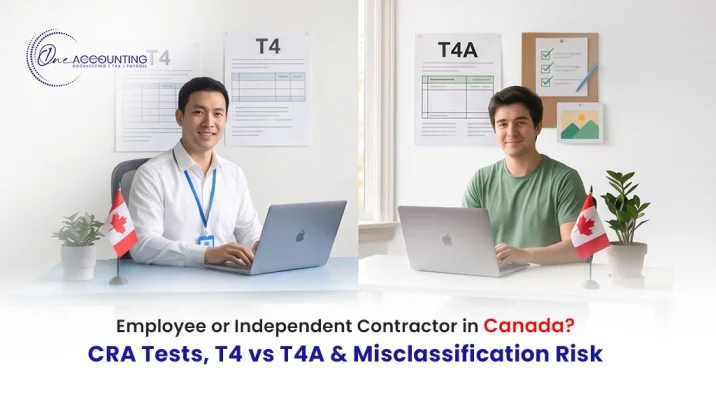
When you hire someone to work for you, agreeing on the fee or salary is not the only important factor to consider. You also need to determine if that person should be categorized as an employee or a self-employed person. Making the wrong decision in this regard may result in unexpected costs, tax recalculations, penalties, and interest.
For small business owners in Canada, the distinction may not be very clear. On the one hand, the freelancer can work for the client for a long time. On the other hand, the contractor can also adhere to the time frame imposed by the company in order to perform the job. Neither of these situations automatically narrows down the category of employment status.
The Canada Revenue Agency considers the actual working relationships instead of merely looking at the title stated in the contract. This guide explains the Canada Revenue Agency (CRA)’s classification factors, the differences between T4 and T4A reporting, and the potential consequences of worker misclassification.
Why Employment Status Matters
An employee and a self-employed worker have different tax responsibilities.
When you hire an employee, you generally deduct Canada Pension Plan (CPP) contributions, Employment Insurance (EI) premiums, and income tax from their pay. You must remit the applicable amounts to the CRA and pay the employer’s share of CPP and EI contributions.
Independent contractors usually invoice your business for their services. The payer generally does not make employee payroll deductions, and the contractor manages their own tax obligations.
Self-employed individuals generally pay both the employee and employer portions of CPP through their personal tax return. They do not contribute to EI as self-employed workers unless they opt into the program for eligible special benefits.
Quebec has different requirements, including the Quebec Pension Plan (QPP) and Quebec Parental Insurance Plan (QPIP).
Understanding these differences helps businesses budget accurately and avoid compliance problems.
Employee vs Independent Contractor in Canada: The Basic Difference
The CRA distinguishes between a contract of service, which describes employment, and a contract for services, which generally describes an independent business providing services.
An employee typically works under the employer’s direction and forms part of its business operations. A self-employed worker generally operates an independent business and has greater control over how the agreed services are delivered.
Factor | Employees | Independent Contractor |
Control | Employer directs the work | Generally controls how work is completed |
Equipment | Often provided by employer | Often supplies their own |
Financial risk | Usually limited | May bear expenses and losses |
Profit | Receives wages or salary | May increase profit through business decisions |
Assistance | Usually performs work personally | May hire helpers or subcontract |
Payroll | CPP, EI, and tax deductions generally apply | Usually manages own tax obligations |
These are general indicators, not definitive rules. An employee using personal equipment does not automatically become self-employed.
How the CRA Decides: The Employee vs Contractor Test
The CRA examines the entire relationship, considering the parties’ intentions and whether the actual working conditions support those intentions. A contract calling someone an independent contractor does not settle the question.
Under the common-law approach used in most provinces, several factors help determine whether someone is an employee or self-employed.
Control: Who decides how, when, and where the work is done? A business that sets working hours, assigns daily tasks, and closely supervises the worker may indicate employment.
Tools and equipment: An employee may use equipment supplied by the employer, while a contractor may invest in their own tools, software or machinery. The nature of the work also matters.
Subcontracting: A contractor who can hire assistants or subcontract work may demonstrate greater independence. Employees are generally expected to perform their assigned duties personally.
Financial risk: Contractors may cover operating expenses, pay for materials, or absorb the cost of correcting mistakes. Employees generally face less direct business risk.
Investment and management: Advertising services, maintaining equipment, and managing business expenses can indicate that someone operates an independent business.
Opportunity for profit: A contractor who quotes a project fee and controls costs may increase their profit through efficient work. Employees generally receive agreed wages or salaries.
The CRA weighs these factors together. No single factor automatically determines status. Quebec uses a different legal framework under its Civil Code.
Signs a Worker May Be an Employee
An employment agreement may be signified if the worker observes the company’s time schedule, is given company equipment, is not able to find substitutes for himself, and continues to be under close control of his supervisors.
Other signs of the employment relationship may include the absence of financial losses connected with the activity performed by the worker, and his participation in the company’s regular employee team.
Signs a Worker May Be Self-Employed
Independent contractors may offer their services to many different customers at once, choose the means of completing each project, provide their own tools and equipment, and pay for all associated costs.
Some other markers are if a contractor has employees, runs advertisements, makes deals with clients regarding fees for their services, and is willing to risk losing money by accepting a project.
However, the presence of multiple contracts and the issuance of invoices is not enough to prove an independent contractor’s status as a self-employed person.
What Happens if You Misclassify a Worker?
Suppose a business treats someone as an independent contractor for two years. The CRA later determines that the worker should have been classified as an employee.
The employer may have to pay outstanding CPP contributions, including the employer and employee shares, along with applicable EI premiums, tax withholding amounts, penalties, and interest.
Payroll records and information returns may also require correction.
A written agreement describing someone as a contractor does not automatically protect the business. If the actual arrangement resembles employment, the CRA may classify the worker accordingly. Reviewing the arrangement early can help prevent costly surprises.
Personal Services Businesses: Does Incorporation Help?
Incorporating does not automatically remove worker-classification risks.
A personal services business (PSB) may arise when an individual provides services through a corporation but would reasonably be considered an employee of the client if the corporation did not exist, provided the other statutory conditions are met.
PSBs face special tax rules. They generally cannot claim the small business deduction or the general tax rate reduction and are subject to an additional 5% tax on PSB income. Their deductible expenses are also restricted.
Incorporated contractors and the businesses hiring them should therefore review the actual arrangement rather than assume that incorporation settles the question.
T4 vs T4A: What Should You Issue?
Choosing the correct tax slip depends on the nature of the payment and the worker’s status.
T4 for employees: A T4 reports employment income and applicable payroll deductions, including CPP contributions, EI premiums, and income tax withheld. Employers must also meet their payroll remittance and year-end reporting obligations.
T4A for service providers: Box 048, labelled Fees for services, is used to report applicable service fees paid to self-employed recipients. The CRA’s administrative policy generally calls for reporting relevant fees exceeding $500 in a calendar year. GST/HST and PST should not be included in box 048.
The CRA’s current administrative policy does not assess penalties for failures to complete box 048, except under its specific trucking-industry policy. Businesses should still review the reporting requirements that apply to them.
Other slips may be necessary in particular circumstances. T4A-NR can apply to certain payments to non-residents for services provided in Canada, while T5018 is used for reporting payments to construction subcontractors when the relevant requirements are met.
Importantly, issuing a T4A does not establish that someone is self-employed. Classification must be assessed separately.
Special Note for the Trucking Industry
The CRA lifted its moratorium on penalties for certain T4A box 048 reporting failures in the trucking industry starting with the 2025 tax year. Businesses operating in this sector should review the applicable reporting rules before filing their information returns.
How to Request a CPP/EI Ruling
If you are uncertain about a worker’s status, either the worker or the payer can request a CPP/EI ruling from the CRA.
Depending on the circumstances, you can submit a request through My Business Account, My Account or an authorised representative using Represent a Client. Form CPT1, Request for a CPP/EI Ruling – Employee or Self-Employed?, is another option.
The CRA generally must receive a request by June 29 of the year following the year in question, subject to applicable deadline rules. Check the current guidance before submitting your request, particularly if an appeal may be necessary.
Checklist Before Hiring a Contractor
Prior to hiring an independent contractor, it is important to make sure to do the following:
- Create writing that accurately describes how the work will be accomplished.
- Request invoices and any necessary business information.
- Check the GST/HST registration requirements, if applicable.
- Determine who is responsible for supplying the equipment, overseeing the work, and sustaining the financial risk.
- Occasionally review the arrangement, especially if responsibilities are modified.
- Get in touch with a CPA when there is confusion about the difference between employment and self-employment.
These actions ensure that there are reliable records in place and support making the right decisions regarding the classification of workers.
How One Accounting Can Help
Oversight of both employees as well as contractors includes duties such as payroll processing, bookkeeping, tax filing, and dealing with the deadlines for the year. One Accounting can help companies comply with these responsibilities through payroll processing, tracking contractor payments, bookkeeping, and T4 or T4A filing.
Explore the firm’s resources on payroll deductions in Canada, payroll services in Toronto, and WSIB filing.
Professional assistance can help firms have their records accurately presented and fix any issues with compliance before they morph into expensive problems.
Conclusion
In Canada, having a written agreement or assigning a particular title to a working relationship is not enough to determine whether a worker is an independent contractor or an employee. The CRA uses several tests to make this determination, considering factors such as the degree of control, the use of tools and equipment, financial risk, and the opportunity to earn a profit from the work performed.
A worker’s classification determines the applicable payroll deduction and reporting obligations. Therefore, reviewing these factors before engaging a worker can help businesses avoid unexpected costs, payroll errors, and incorrect tax filings.
If you’re unsure about a worker’s employment status, One Accounting can help you review the relevant
Share:
Recent Blogs
Top Tax Write-Offs for Small Businesses in Canada
10 Commonly Missed Tax Credits & Deductions for 2026
GST/HST Credit Payment Dates in Canada
What Is a Compilation Engagement?
What Is the Toronto Vacant Home Tax?
Internal auditor vs external auditors

Ashish Nanda
Master's in Accounting — Asst. Accounting Manager, One Accounting
Ashish Nanda holds a Master’s degree in Accounting and serves as Assistant Accounting Manager at One Accounting. With a strong foundation in accounting principles, exceptional analytical skills, and a commitment to financial accuracy, He plays a key role in helping Canadian businesses maintain financial clarity, operational efficiency, and regulatory compliance. Specializing in bookkeeping, corporate tax filings, and financial reporting, He brings a detail-oriented and solutions-driven approach to every aspect of his work.
- Phone: +(437) 837-2102
- Email: [email protected]
