CRA Tax Filing Deadlines 2026: When Is Your Canadian Tax Return Due?
Wondering when the tax return is due in Canada for 2026? For most Canadians, the personal tax filing deadline is April 30, 2026. If you are self-employed, you have until June 15, 2026, to file, although any taxes owed must still be paid by April 30.
Every year, millions of Canadians sit down with a pile of receipts and T4 slips, unsure if they have everything they need to file correctly.
For most people, tax season is not complicated once you know the dates and what applies to your situation. The challenge is that Canada does not have a single universal tax deadline.
Individuals, self-employed taxpayers, corporations, and partnerships each follow a different schedule, and missing the right one can lead to interest charges, penalties, and filing complications with the CRA.
This guide lays out the major tax deadlines for 2026, explains who each one applies to, and covers what happens if you miss it.
When Is the Tax Return Due in Canada (2026)?
For most Canadians, the 2025 personal income tax return is due on April 30, 2026. If you are self-employed, your return is due June 15, 2026, but any taxes owed are still due April 30, 2026. Corporate tax returns are generally due six months after the end of the fiscal year.
| Tax Type | Deadline |
| Personal tax return | April 30, 2026 |
| Self-employed filing | June 15, 2026 |
| Corporate tax return | 6 months after the fiscal year-end |
| Partnership return | March 31, 2026 |
Tax Deadline for Individuals in Canada
For most Canadians, the personal income tax filing deadline is April 30, 2026. This applies to individuals who earned employment income, investment income, rental income, or other taxable income during the 2025 tax year.
If April 30 falls on a weekend or public holiday, the Canada Revenue Agency (CRA) usually extends the deadline to the next business day. In 2026, however, April 30 falls on a Thursday, so the standard filing deadline applies.
Any balance owing is also due by April 30, 2026. Filing your return on time but paying late can still result in interest charges starting May 1, 2026.
In addition to filing deadlines, the RRSP contribution deadline for the 2025 tax year is March 2, 2026. Contributions made by this date can reduce taxable income.
Who Needs to File Individual Taxes in Canada?
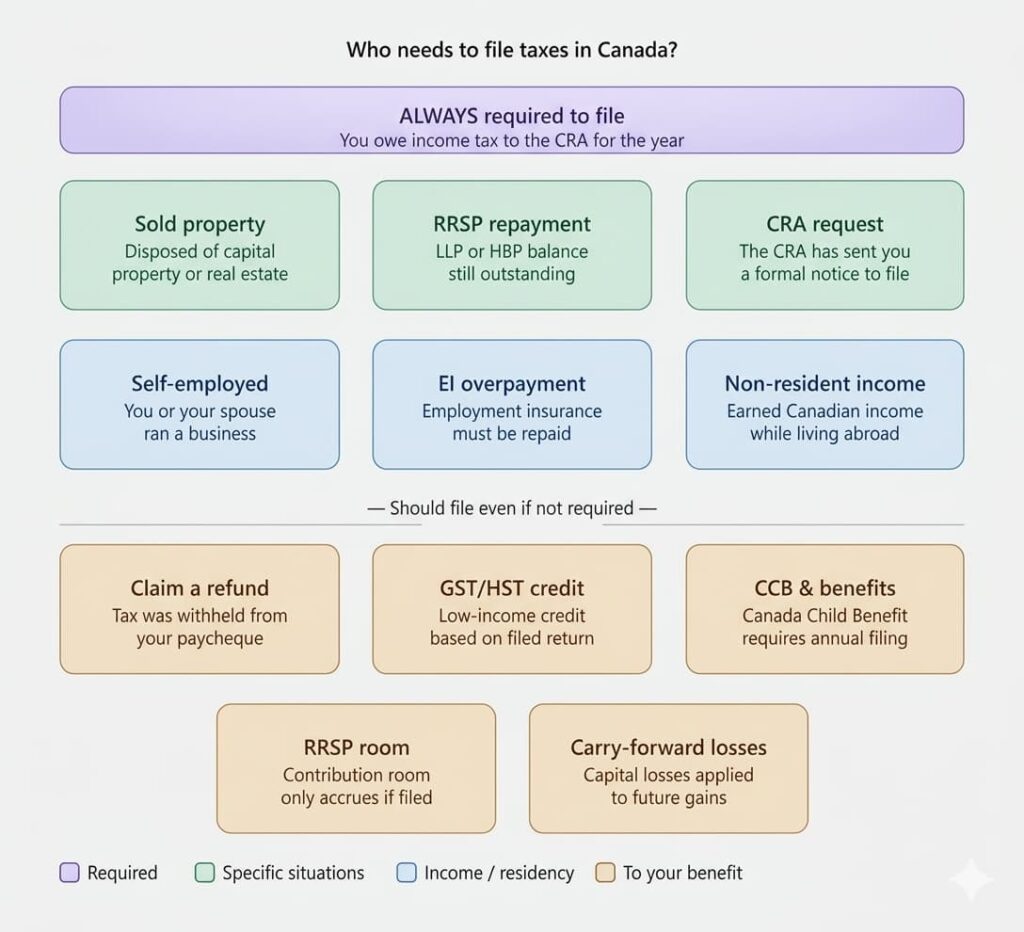
Not every Canadian is legally required to file a tax return, but in many cases, filing is still necessary or simply a smart idea. The Canada Revenue Agency (CRA) generally expects you to file a return if any of the following apply to you:
- You owe taxes for the 2025 tax year
- The CRA asked you to file a return
- You sold capital property or realized a taxable capital gain
- You want to claim a tax refund
- You want to receive or continue receiving benefits such as the GST/HST credit, Canada Child Benefit, or Climate Action Incentive Payment
- You or your spouse/common-law partner contributed to the Canada Pension Plan (CPP) based on self-employment income
- You repaid Employment Insurance (EI) benefits or Old Age Security (OAS) payments
Even if you had no income in 2025, filing a tax return can still be worthwhile. It may help you stay eligible for federal and provincial benefits, credits, and future CRA payments.
What Happens If an Individual Misses the Tax Deadline?
Missing the April 30, 2026, tax deadline can lead to penalties and interest if you owe taxes.
The Canada Revenue Agency (CRA) will charge you 5% of the amount you owe, plus 1% for each full month your return is late, up to a maximum of 12 months. In addition, compound daily interest begins accumulating on any unpaid balance starting May 1, 2026.
If you were charged a late-filing penalty in any of the previous three tax years, the penalty can increase to 10% of your balance owing, plus 2% per month for up to 20 months.
The CRA usually does not charge a late-filing fee if you owe a refund and file late. But if you file late, it could take longer for benefits or credits that depend on your tax return to be paid.
Tax Deadline for Self-Employed Individuals in Canada
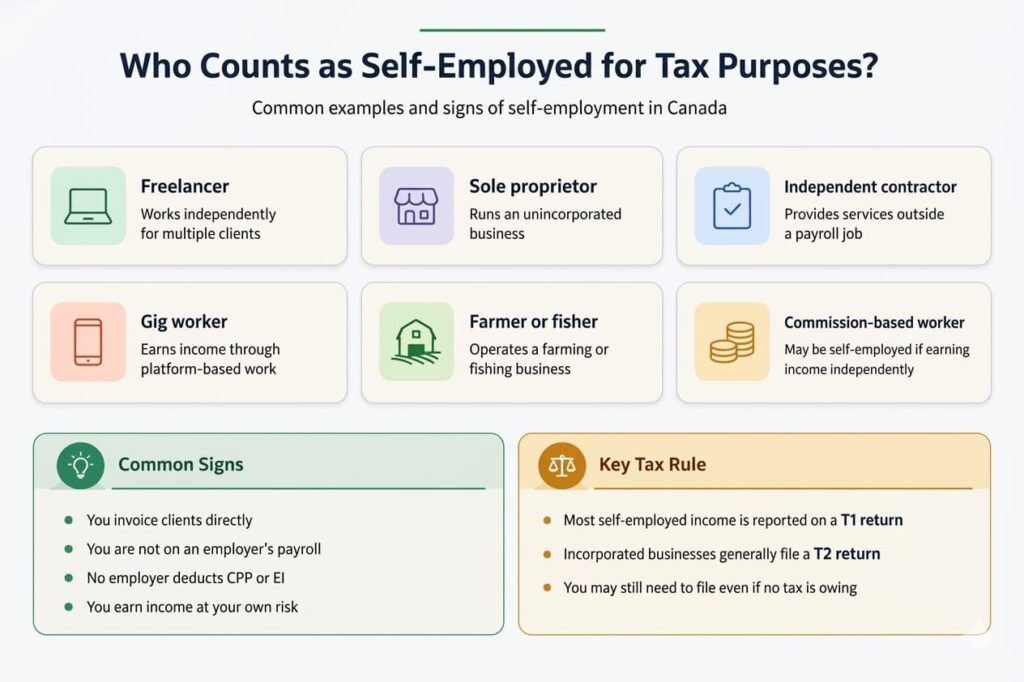
Self-employed individuals, as well as their spouses or common-law partners, have until June 15, 2026, to file their 2025 T1 personal income tax return.
This extended filing deadline gives self-employed Canadians more time to organize business income, expenses, and other tax records after the end of the tax year.
There is one important catch: any taxes owed are still due by April 30, 2026. If you wait until June to file and have a balance owing, interest begins accumulating on the unpaid amount starting May 1, 2026. The later filing deadline does not extend the payment deadline.
Who Is Considered Self-Employed for Tax Purposes?
You are self-employed if you carry on a business on your own account, not through an incorporated company. The CRA generally considers you self-employed if you bear the financial risk associated with your work.
What Happens If a Self-Employed Person Misses the Deadline?
The late-filing penalty for self-employed individuals is generally the same as for other personal tax filers: 5% of the balance owing, plus 1% for each full month the return is late, up to a maximum of 12 months.
However, self-employed taxpayers face an extra challenge. Although the filing deadline is June 15, 2026, any taxes owed are still due by April 30, 2026. This means that if you owe money and wait until June to file, interest may already be accumulating on your unpaid balance starting May 1, 2026.
In practical terms, many self-employed Canadians are better off estimating their tax bill and paying by April 30, even if their return is not fully ready. You can file later and adjust for any overpayment or underpayment once the return is completed.
Corporate Tax Return Deadline in Canada
Canadian corporations must file a T2 Corporation Income Tax Return within six months of the end of their fiscal year. Because corporations can choose any fiscal year-end, the deadline varies:
- December 31 year-end → file by June 30
- March 31 year-end → file by September 30
The 6-month filing window begins the day after the corporation’s fiscal year-end, so the deadline is not tied to one fixed date for all businesses.
Balance Due vs. Filing Deadline
The balance owing is due much sooner than the return itself:
- Most CCPCs: balance owing due within 2 months of the fiscal year end
- CCPCs qualifying for the small business deduction: balance due within 3 months
For example, a corporation with a December 31 year-end may need to pay its balance owing by February 28 or March 31, even though the T2 return itself is not due until June 30.
Who Must File a Corporate Tax Return?
In Canada, every corporation resident in Canada generally has to file a T2 Corporation Income Tax Return for each tax year, even if:
- No tax is owing
- The corporation had no income or business activity during the year
This can include:
- Inactive corporations
- Holding companies
- Some tax-exempt not-for-profit corporations
In some cases, non-resident corporations may also need to file if they carried on business in Canada or disposed of taxable Canadian property.
Penalties for Missing the Deadline
- Late-filing penalty: 5% of the unpaid tax balance at the time of filing, plus 1% for each complete month the return is late, up to 12 months.
- Repeat offenders: Penalties may double if a late-filing notice was issued in any of the prior 3 years.
- Daily compound interest: Accrues on unpaid balances at the CRA’s prescribed rate starting the day after the balance was due.
Large corporations may also face additional instalment penalties.
GST/HST Filing Deadlines
Monthly filers
- Due one month after the end of each reporting period
Quarterly filers
- Due one month after the end of each quarter
Annual filers
- Due three months after your fiscal year-end
How Does Tax Filing Work in Canada?
In Canada, tax season runs from February to April each year. The Canada Revenue Agency (CRA) is the federal body responsible for collecting taxes and administering tax laws. Most Canadians file a T1 General Income Tax and Benefit Return annually, reporting their income, claiming deductions and credits, and either receiving a refund or paying a balance owing.
You can file online using NETFILE-certified software, through a tax professional, or by mailing a paper return. For most Canadians, both the filing and payment deadlines are April 30. Self-employed individuals have until June 15 to file, but any taxes owed are still due by April 30.
FAQ's
When is the tax return due in Canada (2026)?
The 2025 personal tax return is due April 30, 2026. Self-employed individuals must file by June 15, 2026, but any balance owing is still due April 30, 2026.
Do I need to file taxes if I had no income?
Not require. But filing keeps you eligible for credits like the GST/HST credit and Canada Child Benefit.
When does tax season start in Canada?
Tax season begins in February, when most tax slips are issued, and the CRA opens filing.
When is the U.S. tax return due?
In the United States, the standard individual tax filing deadline is typically April 15 each year, unless the date falls on a weekend or holiday. This article focuses on Canadian tax deadlines for 2026.
Share:
Recent Blogs
Everything You Need to Know About Quebec Payroll
The Ultimate Guide to Canadian Year-End Payroll
What you need to know about Canada’s New Dental Care Plan
Disclaimer: Information shared in this blog is general in nature and may not apply to all situations or circumstances. Contact One Accounting for accurate, professional advice.

Kamal Harichandran
Masters in Accounting — Asst. Accounting Manager, One Accounting
Kamal Harichandran holds a Master's degree in Accounting and serves as the Assistant Accounting Manager at One Accounting. Kamal specialises in bookkeeping, payroll, and corporate tax filings, working closely with the management team to deliver efficient and accurate financial services to clients. His academic background and practical experience give him a thorough command of accounting standards and compliance requirements in Canada. Kamal is dedicated to helping businesses stay organised, compliant, and financially informed, contributing significantly to the firm's reputation for reliable and professional service.
- Phone: +1 647-847-4858
- Email: [email protected]
