What Is a Compilation Engagement?
If you own a small business in Canada, you may have encountered the term “compilation engagement,” perhaps during conversations with your accountant or when a lender requested financial statements. If you were confused by what it means, you’re not alone.
A compilation engagement might sound technical, but it’s one of the simplest financial reporting services a CPA can provide to businesses.
In this guide, we’ll dive into what a compilation engagement entails, the CPA’s responsibilities in performing one, and how to determine if it makes sense for your business.
What Is a Compilation Engagement Report?
A compilation engagement report is a set of formal financial statements that your CPA prepares from the financial information your business provides. The CPA organizes the information into a recognized format, but does not verify the numbers, test transactions, or provide any assurance regarding the accuracy or completeness of the information.
What Is a Notice to Reader?
If your accountant or bank has ever used the term “Notice to Reader” or “NTR,” they are referring to the same thing as a compilation engagement report.
Notice to Reader was the name used in Canada before 2021, when the Canadian Standard on Related Services (CSRS 4200) came into effect and introduced updated guidelines and terminology. CPAs, lenders, and banks still use both terms interchangeably, so it’s worth knowing they mean the same thing.
Purpose of a Compilation Engagement Report
Most small business owners need compiled financial statements for one of a few practical reasons:
- Bank or lender requests: When you apply for a business loan or line of credit, most lenders want to see formal financial statements. A compilation report gives them a standardized view of your business finances without requiring a full audit.
- Corporate tax filing:Incorporated businesses in Canada need formal financial statements to file their T2 corporate tax return. A compilation engagement is usually the most straightforward way to get that done at year-end.
- Internal planning: Having your numbers properly organized once a year gives you a clearer picture of how the business is actually performing.
- General compliance and record-keeping:Some industries and jurisdictions expect businesses to maintain formal financial records. Compiled statements help you stay organized and ready if a third party ever asks for documentation.
Who Can Prepare a Compilation Engagement?
- Only a licensed CPA can prepare and sign a compilation engagement report in Canada under CSRS 4200.
- Bookkeepers can organize your records and keep your books clean, but they cannot sign off on formal financial statements.
- Well-maintained books from a bookkeeper serve as input to the process: the compiled financial statements are the output, and only a CPA can produce them.
- If your business is incorporated, your CPA will usually handle your T2 corporate tax return alongside the compilation at year-end.
What Is Included in a Compilation Engagement Report?
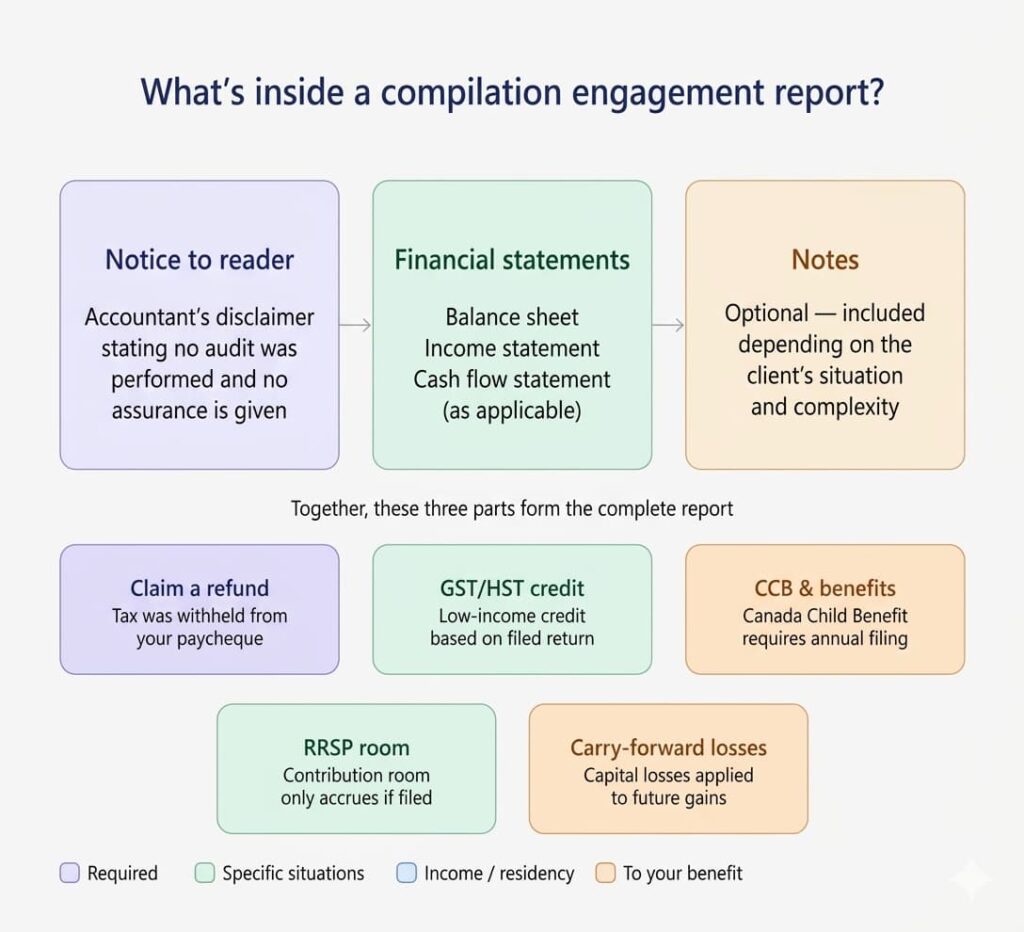
A compilation engagement report usually includes the following:
- A Notice to Reader disclaimer
- Financial statements (such as a balance sheet and income statement)
- Notes to the financial statements
When Do Small Business Owners Need Compilation Engagement Services?
Small business owners typically need compilation engagement services in the following situations:
- When applying for a bank loan or line of credit, as lenders often require formal financial statements
- When bringing in a new business partner or investor who wants to see organized financial statements
- When selling the business, a buyer may request financial documentation
- When filing certain government or regulatory applications that require prepared statements
- When your business has grown to the point where informal bookkeeping is no longer enough, and you need professional financial organization
- When you simply want clean, professional financial statements without the cost of a full audit or review
Regulatory Standards for Compilation Engagement Reports
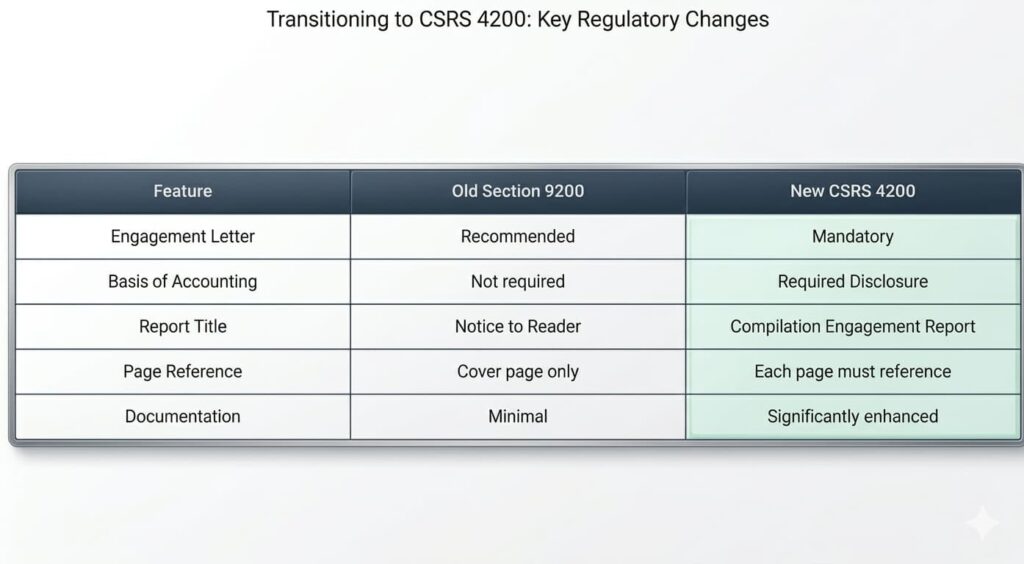
CSRS 4200 (Canadian Standard on Related Services) is the professional standard that governs how accountants in Canada must conduct and report on compilation engagements. It came into effect for periods ending on or after December 14, 2021, replacing the older Section 9200.
Why Was It Introduced?
The old Section 9200 had been in place for decades and didn’t reflect modern business needs or provide enough clarity for accountants or their clients. CSRS 4200 was designed to make the process more transparent and to better define the responsibilities of both the accountant and the business owner.
Who Issues and Oversees It?
CSRS 4200 is issued by the Auditing and Assurance Standards Board (AASB), which operates under CPA Canada. All CPA members performing compilation engagements in Canada are required to follow it.
What Changed With CSRS 4200?
- A written engagement letter is now mandatory. Previously, this was recommended but not required.
- The Notice to Reader must now appear on each page of the financial statements, not just as a cover page.
- The accountant must now explicitly state the basis of accounting used (e.g., GAAP, cash basis, or another framework).
- If the financial statements contain a known departure from the stated framework, the accountant must disclose it in the report.
- The standard introduced a clearer distinction between compilations done with notes and those without notes.
What Stays the Same?
- No audit or review is performed. The accountant provides no assurance.
- The business owner remains fully responsible for the accuracy of the financial information.
- The report is not suitable for situations where assurance is required (such as some high-value lending situations).
Benefits of Compilation Engagement Services
- Provides cost-effective financial statement preparation without the complexity of audits or reviews.
- Boosts the credibility and professionalism of financial reports for lenders, stakeholders, and internal decision-makers.
- Reduces errors with standardized and accountant-prepared documentation.
- Best for internal planning and decision-making.
Limitations of Compilation Engagement Reports
A major drawback of compilation engagement reports is that they don’t guarantee the accuracy or completeness of the financial statements. Accountants don’t verify, test, or analyze the information provided. These reports might not be suitable for external financing, legal proceedings, or investor decisions that need a higher level of assurance. Since the report relies on information from management, there’s a greater chance that mistakes or inaccuracies could go unnoticed.
Conclusion
Your financial statements are often the first thing lenders or investors review. If they are disorganized or unprofessionally prepared, opportunities slip away before a conversation even begins.
Compilation engagement services exist specifically for businesses that need credible, well-prepared financial statements without the cost of a full audit.
Share:
Recent Blogs
Everything You Need to Know About Quebec Payroll
The Ultimate Guide to Canadian Year-End Payroll
What you need to know about Canada’s New Dental Care Plan
Disclaimer: Information shared in this blog is general in nature and may not apply to all situations or circumstances. Contact One Accounting for accurate, professional advice.

Leya Koshy
CA — Accounting Director, One Accounting
Leya Koshy is a Chartered Accountant (CA) and the Accounting Director at One Accounting. With a strong foundation in accounting principles and Canadian tax regulations, Leya leads the accounting operations at the firm with precision and professionalism. She plays a key role in delivering accurate financial reporting, corporate compliance, and client advisory services across the firm's diverse client base. Her commitment to excellence and detail-oriented approach ensures that clients receive the highest standard of accounting support, helping businesses maintain financial clarity and confidence.
- Phone: +1 416-278-1283
- Email: [email protected]
