Ontario Small Business Tax Rate 2026: What the Proposed Cut Means for Your Bottom Line
If you are running a business in Ontario, the 2026 Provincial Budget has likely caught your attention. The government has signaled a clear intent to support the local economy by proposing a meaningful reduction in the Small Business Tax Rate.
At One Accounting, we know that even a 1% shift in tax obligations can translate into thousands of dollars reinvested into your equipment, your team, or your growth strategy. However, there is a lot of “noise” regarding when these changes take effect and how they interact with federal rates.
Here is a comprehensive breakdown of the 2026 Ontario tax landscape and how you should prepare your filings.
Is the Ontario Small Business Tax Rate Officially Lower?
The short answer is not quite yet.
The reduction was a headline feature of the 2026 Ontario Budget, but as of this writing, it remains a proposal. In the Canadian legislative process, budget announcements must be drafted into a bill and passed through provincial parliament to receive Royal Assent before becoming law.
The Takeaway: For your immediate Q1 and Q2 2026 tax planning, you must continue to calculate your liabilities based on the current 12.2% combined rate. If you need a refresher on upcoming deadlines, view our guide on CRA Tax Filing Deadlines 2026.
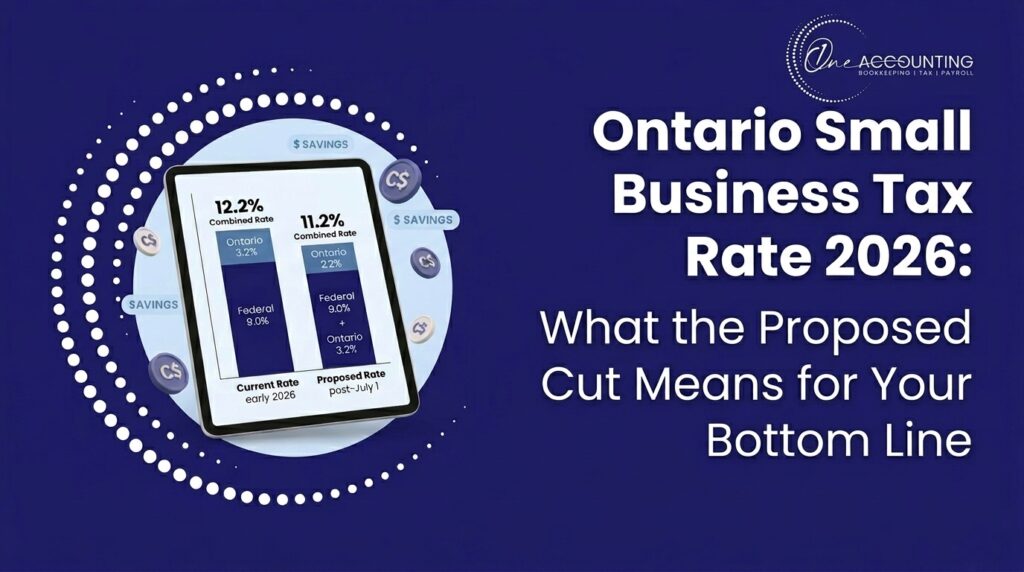
Comparing the Numbers: Current vs. Proposed 2026 Rates
| Tax Component | Current Rate (Early 2026) | Proposed Rate (Post-July 1) |
| Federal Small Business Rate | 9.0% | 9.0% |
| Ontario Provincial Rate | 3.2% | 2.2% |
| Combined Corporate Rate | 12.2% | 11.2% |
The "Split Year" Complexity
Because the proposed effective date is July 1, 2026, most Ontario corporations will deal with a “blended” or “split” tax year. If your fiscal year end is December 31, your effective provincial rate for the 2026 tax year will likely sit around 2.7%.
This calculation is vital for your mid-year financial statements. Accuracy here prevents over remitting to the CRA and keeps your cash flow predictable. Our professional bookkeeping services can help ensure your mid-year reports reflect these blended rates accurately.
Case Study: How Much Can a Toronto or Burlington Business Save?
Let’s look at a practical example. Suppose your small business earns $500,000 in active business income (the threshold for the small business deduction in Ontario).
- Under the old 12.2% rate: Your total tax bill would be approximately $61,000.
- With the 2026 mid-year adjustment: Your total tax bill drops to approximately $58,500.
- The Result: An immediate savings of $2,500 for the 2026 calendar year.
In 2027, when the 2.2% rate is active for the full twelve months, those annual savings jump to $5,000. For a growing company, that covers a month of marketing spend, a new laptop, or a significant contribution to a group RRSP.
Addressing the "1.6% Rate" Rumors (Bill 12)
You may have heard whispers about a potential drop to a 1.6% provincial rate.
This stems from Bill 12, a separate piece of legislation that has been discussed in policy circles. It is important to distinguish this from the 2026 Budget. While a 1.6% rate is an exciting prospect for the future of Ontario’s business climate, it is not part of the current budget implementation. We recommend keeping your sights set on the 2.2% target for your current projections.
FAQ's
Does this tax cut apply to all businesses?
This specific reduction is aimed at the Small Business Deduction (SBD). Generally, this applies to Canadian-controlled private corporations (CCPCs) on the first $500,000 of active business income.
When should I update my tax installments?
Do not adjust your installments until the legislation is officially passed. Over-adjusting early could result in interest charges if the bill’s implementation date shifts during the legislative process.
Does this change my federal tax obligations?
No. The federal small business rate remains steady at 9%. This is strictly an Ontario provincial initiative.
Strategic Advice: How to Prepare Now
Even though the law isn’t “on the books” yet, savvy business owners should take the following steps:
- Review Your Fiscal Year-End: If your year-end falls shortly after July 1st, your “blended rate” calculation will be different from a December year-end. Consult with your accountant to get the exact percentage.
- Optimize Expense Records: As always, tax savings are only effective if your bookkeeping is airtight. Ensure your receipts and payroll remittances are up to date.
- Plan for Reinvestment: If you know a $2,500–$5,000 windfall is coming, start planning how that capital can best serve your 2027 goals.
Need a Professional Review of Your Corporate Taxes?
Navigating provincial budget changes while running a business is a heavy lift. At One Accounting, we specialize in helping small businesses in Toronto, Burlington, and across Canada maximize their tax efficiency.
Contact Your One Accounting Advisor Today to see how we can help you navigate the 2026 tax season with confidence.
Share:
Recent Blogs
Everything You Need to Know About Quebec Payroll
The Ultimate Guide to Canadian Year-End Payroll
What you need to know about Canada’s New Dental Care Plan
Disclaimer: Information shared in this blog is general in nature and may not apply to all situations or circumstances. Contact One Accounting for accurate, professional advice.

Keith Jacob Noronha
CA — Accounting Manager, One Accounting
Keith Jacob Noronha is a Chartered Accountant (CA) and the Accounting Manager at One Accounting. Keith brings strong technical expertise in bookkeeping, corporate tax compliance, and financial management, supporting a wide range of business clients across Canada. As Accounting Manager, he oversees day-to-day accounting operations, coordinates client engagements, and ensures that all deliverables meet the firm's high standards for accuracy and timeliness. Keith's hands-on approach and deep understanding of Canadian accounting practices make him a trusted resource for clients navigating complex financial requirements.
- Phone: +1 647-556-1299
- Email: [email protected]
