Small Business Bookkeeping Checklist We Use for Year-Round Support
At One Accounting, we know that managing your business finances can feel overwhelming. That’s why we support small businesses and beyond with tailored bookkeeping solutions that provide clarity and control throughout the year.
Our bookkeeping experts combine advanced technology with personalized attention, helping you stay organized, meet compliance requirements, and grow confidently.
In this guide, we’re sharing the small business bookkeeping checklist we use to support our clients all year long. This approach not only reduces stress during tax season but also helps you make better decisions day to day. Let’s dive in.
I. Daily Tasks
Daily bookkeeping tasks are the foundation of a solid financial system. These small but consistent efforts ensure your records remain accurate and up to date. They also make your weekly and monthly reviews faster and easier. By handling a few key tasks each day, you build financial discipline into your workflow.
Daily consistency is the key to success in small business bookkeeping. Start with the steps as follows:
a. Check Cash Position
Start and end your day by reviewing your bank balances and petty cash. This gives you a real-time understanding of how much money you have available for business expenses. It also helps detect any unusual or unauthorized activity early. Staying aware of your cash flow keeps you in control of your financial decisions.
b. Record Transactions
Every sale, expense, and payment should be logged as soon as it happens. Whether it’s a customer payment or a supply purchase, prompt entry prevents missing data and confusion later. Use your bookkeeping software or a spreadsheet to capture these details. Accurate transaction records are vital for trustworthy reports.
c. Update Bookkeeping Software
Daily software updates help categorize entries accurately and flag discrepancies. When your data is current, your reports are more meaningful and your decisions better informed. Choose a system that syncs with your bank accounts and integrates with invoicing tools. This automation makes small business bookkeeping easier to manage.
Keeping up with these daily tasks supports smooth financial operations and gives you the confidence to focus on growing your business.
Once your daily routine is in place, weekly tasks help you spot trends and stay on track. Let’s look at what you should review and update every week to support your financial health.
II. Weekly Tasks
Once your daily entries are handled, weekly bookkeeping gives you a chance to review your finances from a broader perspective. These tasks help catch errors early and make sure cash is flowing properly.
By setting aside time each week, you can avoid bottlenecks and stay ahead of your deadlines. It’s also a great way to reduce the stress of the month-end.
Each week brings a new opportunity to tighten up your records. Focus on the following:
a. Reconcile Bank & Credit Card Accounts
Reconciliation means comparing your bank and credit card statements with your bookkeeping records. This helps spot double charges, missed payments, or bank errors before they become a bigger issue. Doing this weekly keeps your accounts clean and ensures your books match your actual financial activity. It also builds a habit that saves you time later.
b. Send and Review Invoices
Cash flow depends on how fast your customers pay you. Sending invoices promptly and reviewing unpaid ones weekly can boost collections. Don’t hesitate to send polite follow-ups for overdue payments. Consistent follow-up increases the likelihood of getting paid on time.
c. Pay Bills and Record Vendor Payments
Set aside time weekly to pay bills and update your records. Late payments can lead to penalties and hurt vendor relationships. Timely payments also keep your expenses predictable. Always record these transactions to maintain accurate financial reports.
d. Upload Receipts for Digital Tracking
Storing receipts digitally makes tax season easier and saves you from lost paperwork. Use a scanner or bookkeeping app to upload receipts weekly. Match them with transactions in your books for a clear audit trail. This practice supports efficient small business bookkeeping.
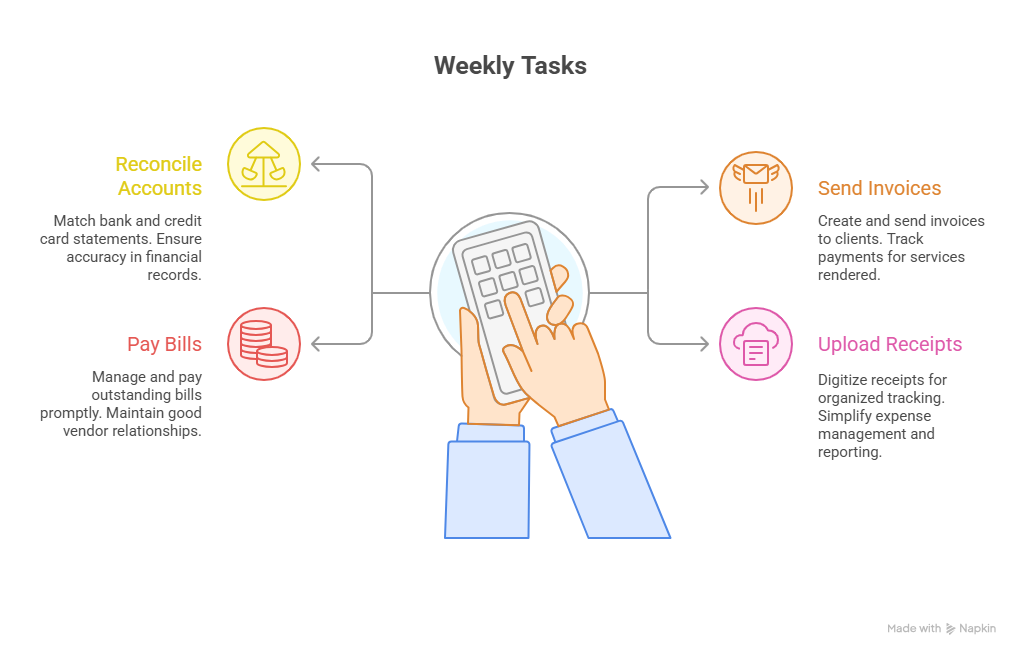
These weekly tasks are a powerful way to prevent small issues from snowballing into big problems.
Monthly tasks help connect the dots between your weekly records and long-term goals. Once weekly reviews are under control, it’s time to focus on monthly financial management.
III. Monthly Tasks
Monthly bookkeeping brings everything together. It’s a deeper dive into your financial health and helps identify trends and issues before they escalate. Monthly reviews help you make data-driven decisions and keep your business ready for tax time. By following this part of the checklist, you gain a clearer view of where your money is going.
To get a clear financial picture, complete the actions as follows:
a. Full Account Reconciliation
Each month, verify that your bookkeeping records match your bank, credit card, and merchant service statements. This goes beyond weekly checks and ensures no transactions are missed. Accurate reconciliation helps avoid tax reporting issues. It also confirms that your income and expenses are properly documented.
b. Categorize Income and Expenses
Proper categorization ensures your profit and loss reports reflect reality. Review each transaction and assign it to the correct account. Misclassified expenses can distort your financial reports and lead to incorrect tax filings. Good categorization supports better budgeting and tax planning.
c. Run Financial Reports
Generate profit and loss, balance sheet, and cash flow reports every month. These give you insights into your income, spending, and overall financial health. Regular reporting helps detect problems early. It also allows you to adjust spending or revenue strategies if needed.
d. Monitor Receivables and Payables
Check what customers still owe you and which bills you need to pay. Aging reports can help you prioritize collections and avoid late fees. This keeps your cash flow steady and ensures no obligations are missed. It’s a vital step in maintaining healthy business finances.
e. Process Payroll and Tax Obligations
If you have employees, make sure payroll is processed on schedule. Also, review your tax obligations and remit any necessary payments. Late or incorrect filings can result in penalties. Using a system to automate these tasks can simplify compliance.
f. Backup Financial Data
Protect your data by creating backups at the end of each month. Use secure cloud storage or external drives. Regular backups reduce the risk of data loss due to theft, software issues, or human error. This habit builds resilience into your bookkeeping system.
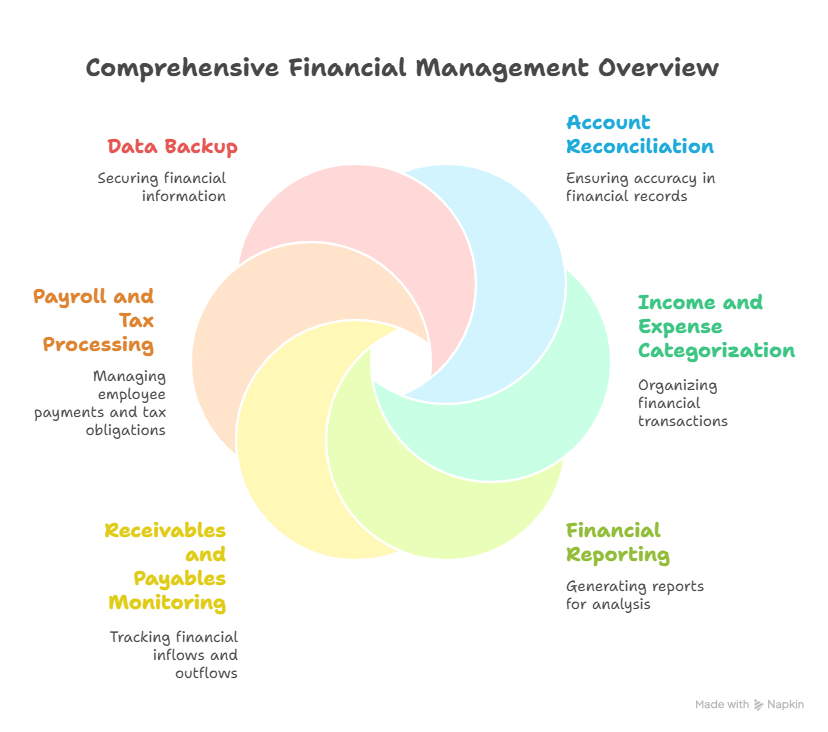
Monthly reviews help strengthen your small business bookkeeping and prepare you for each quarter.
Once you’ve tackled the monthly tasks, quarterly reviews help sharpen your financial decisions. To keep your business agile, here’s what you should focus on every quarter.
IV. Quarterly Tasks
Quarterly bookkeeping is about review and refinement. It’s your chance to correct the course, evaluate your progress, and make strategic decisions. These tasks are especially important for businesses that file taxes quarterly. Even if you don’t, quarterly check-ins keep your records current and comprehensive.
Plan ahead and stay compliant by focusing on the quarterly tasks below:
a. Inventory Review
If you manage physical inventory, check for discrepancies between recorded and actual stock. Adjust your records to reflect true counts and values. Accurate inventory data ensures correct cost of goods sold. It also helps with forecasting and purchasing decisions.
b. Prepare and Pay Quarterly Taxes
Many small businesses are required to pay estimated taxes quarterly. Calculating and submitting these payments on time avoids penalties. Keep all payment confirmations for your records. Staying on top of this shows discipline in your small business bookkeeping.
c. Clean Up Chart of Accounts
Review your account structure and merge duplicate or unused accounts. A clean chart makes reporting easier and reduces confusion. It also improves the accuracy of your financial insights. This task keeps your books efficient and easier to manage.
Quarterly tasks give you a snapshot of performance and help optimize for the months ahead.
To finish strong, here’s what your small business bookkeeping checklist should include at year-end.
V. Year-End Tasks
Year-end is the final checkpoint of your financial journey. This is when all your efforts throughout the year come together. These tasks are essential for tax filing, compliance, and evaluating your business performance. With proper year-end preparation, tax season becomes much more manageable.
For a stress-free tax season and accurate reporting, follow the year-end tasks below:
a. Organize and Archive Documents
Sort and file all your financial documents for the year. This includes receipts, invoices, bank statements, and tax forms. Proper organization ensures quick access during tax time. Use both digital and physical storage to safeguard your records.
b. Reconcile All Accounts Thoroughly
Perform a complete reconciliation of every financial account. This includes banks, loans, credit cards, and inventory systems. Resolving discrepancies now prevents complications during tax filing. Clean records are a sign of strong small business bookkeeping.
c. Review Payroll Details and File W-2s/1099s
Verify that employee and contractor payments were recorded correctly. Prepare and file W-2s and 1099s before government deadlines. This shows your commitment to compliance. It also fosters trust among your team and vendors.
d. Depreciation and Fixed-Asset Review
Update your fixed asset register and calculate depreciation for each item. This ensures accurate balance sheet reporting. Work with your accountant to confirm all tax rules are applied. This can affect your deductions and overall tax liability.
e. Close Temporary Accounts
Revenue and expense accounts should be closed to start fresh in the new year. This process resets your books and ensures the accuracy of your opening balances. Use your bookkeeping software to handle this efficiently. It also helps produce clean year-end reports.
f. Generate Annual Reports
Produce your final profit & loss, balance sheet, and cash flow reports. These documents show how your business performed over the year. Review them with your accountant for insights and planning. Annual reports are key tools for investors and loan applications.
g. Backup and Archive Data
Make a complete backup of your financial data and reports. Store it securely and keep multiple copies. This protects your information and helps with audits or reviews. Backups are a smart end-of-year routine.
h. Meet With Your Accountant
Schedule a meeting with your bookkeeper or accountant to review the year. Discuss what went well and what can improve. This is also the time to plan for the year ahead. At One Accounting, we help clients with year-end strategy and filings to ease this process.
With these tasks complete, you can close your books with confidence.
To see how these monthly accounting and bookkeeping tasks play out in real-life scenarios, here’s a peek at a Reddit conversation where small business owners discuss their go-to routines, biggest challenges, and tips for staying on top of the numbers every month.

Now that we’ve covered the main checklist, here are a few extra steps to level up your bookkeeping.
VI. Ongoing Best Practices
In addition to your checklist, strong habits make bookkeeping smoother. These best practices support accuracy and save you time.
Aside from scheduled tasks, strong bookkeeping depends on best practices like the following:
a. Choose the Right Accounting Method
Decide between cash and accrual accounting based on your business needs. Cash accounting is simple, while accrual gives a fuller picture. Talk to your accountant about what’s best for you. The right method supports accurate small business bookkeeping.
b. Stick to Double-Entry Bookkeeping
This method records each transaction in two places, reducing errors. It provides checks and balances in your books. Most accounting software follows this model. Understanding it helps you catch mistakes and interpret your data.
c. Use Quality Software and Automation
Choose tools that integrate with your bank, invoicing, and payroll. Automation can save hours each week. It also reduces the chances of human error. Good software is an investment in efficient bookkeeping.
d. Separate Personal and Business Finances
Always use different accounts and credit cards for your business. This simplifies reporting and protects your liability status. Blurred finances are hard to untangle at tax time. Keeping them separate is one of the easiest ways to maintain clean records.
Following these habits alongside the checklist helps you stay organized and compliant.
By following these tasks throughout the year, you’re setting your business up for long-term financial success. Now that we’ve covered every step in the checklist, let’s take a moment to recap what it all means for your business.
Conclusion
At One Accounting, we believe great bookkeeping is the foundation of business success. With our year-round checklist, you can stay ahead of deadlines, understand your finances, and feel confident making decisions. From daily data entry to year-end tax prep, our experts offer personalized support tailored to your business.
Whether you need full-service small business bookkeeping or just a bit of help each month, we’re here to help you stay organized, compliant, and focused on growth. Let’s build your business success together, one ledger at a time.