The Rise of AI in Canadian Bookkeeping and Accounting Practices

Managing your finances can feel overwhelming, especially when you’re trying to juggle multiple responsibilities. But with smart technology like AI, staying on top of your books has never been easier. One Accounting uses innovative tools to simplify bookkeeping and accounting for businesses and individuals alike.
Artificial Intelligence is making big changes in the financial industry in Canada. From reducing human error to making smarter financial decisions more quickly, AI helps firms stay competitive.
Let’s start by understanding how AI began making its mark in Canadian accounting.
I. Evolution of AI in Canadian Accounting
The adoption of AI in Canada’s bookkeeping and accounting industry has grown rapidly. Businesses are now seeing the value of AI in simplifying processes and improving accuracy. As demand increases, AI is becoming a must-have rather than a nice-to-have.
To understand the growing role of artificial intelligence in Canadian accounting, we must first examine its evolution through the following:
a. Overview of AI adoption in Canada's accounting sector
Canadian firms have started integrating AI in daily operations into improve speed and reduce manual labor. From cloud platforms to chatbots, AI has touched every part of bookkeeping and accounting. This adoption trend continues to grow each year.
b. Key drivers: technological advancements, regulatory changes, and market demands
AI adoption is driven by several key forces:
- Growing access to cloud-based accounting tools
- Stricter compliance needs from CRA and provincial bodies
- Pressure from clients for faster, digital-first financial services
These factors are accelerating change in the bookkeeping and accounting landscape.
Advanced tools, changing tax laws, and increased competition are pushing firms to modernize. AI helps meet these demands efficiently. Bookkeeping and accounting now require both digital and human expertise.
c. Statistics highlighting the growth of AI tools in accounting practices
Recent surveys show over 40% of Canadian accountants now use or plan to use AI-powered tools. This number has doubled over the last three years. It reflects how fast bookkeeping and accounting are evolving.
Now that AI is established, let’s see how it’s taking over the most time-consuming tasks.
II. Automation of Routine Tasks
AI takes the pain out of repetitive tasks like sorting receipts, entering data, and reconciling bank statements. By handling these automatically, it saves time and reduces mistakes. That means fewer headaches and more accurate books for you.
To understand how AI streamlines daily bookkeeping tasks, let’s take a closer look at the automation benefits outlined below:
a. How AI automates data entry, invoice processing, and bank reconciliations
AI simplifies common bookkeeping processes such as:
- Scanning and entering receipt data
- Auto-tagging expenses to proper accounts
- Matching bank transactions in real-time
b. Impact on reducing human errors and increasing efficiency
With AI handling numbers, the chances of costly mistakes go down. Automation ensures more accurate records and reports. This leads to smoother audits and cleaner books.
c. Examples of tools like QuickBooks and Xero integrating AI for automation
QuickBooks uses AI to auto-categorize expenses and reconcile bank feeds. Xero offers AI for invoice scanning and transaction tracking. Both tools enhance your bookkeeping and accounting process.
Beyond automation, AI is making smarter decisions possible. Next, we explore how AI helps turn raw data into actionable business intelligence.
III. Enhanced Financial Analysis and Forecasting
With AI, financial planning becomes much easier and more reliable. It analyzes large amounts of data and gives you predictions that help you plan better. That means you can make informed decisions, not just educated guesses.
To see how AI enhances forecasting and planning in modern accounting, consider its primary applications as follows:
a. Utilization of AI for predictive analytics and financial modeling
AI tools can:
- Predict future cash flow
- Model revenue and expense trends
- Forecast tax liabilities ahead of time
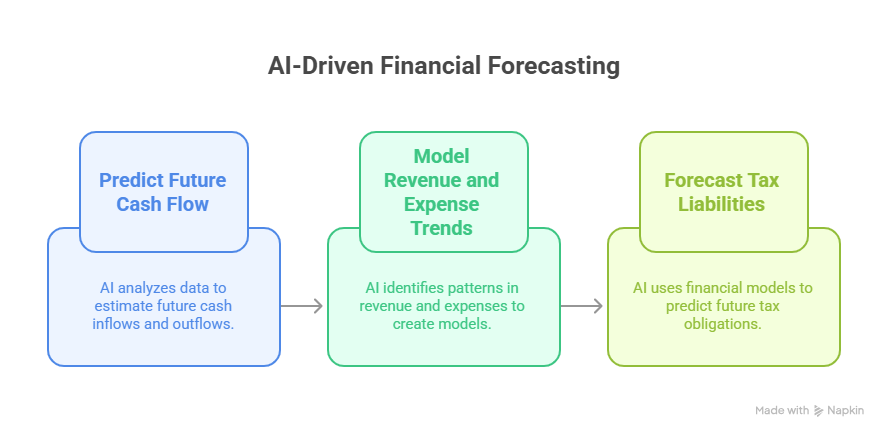
AI can forecast future trends using past data and patterns. This helps business owners prepare for seasonal shifts and cash flow issues. It turns bookkeeping and accounting into a decision-making tool.
b. Real-time data analysis aiding in strategic decision-making
While planning is crucial, staying compliant is non-negotiable. Let’s look at how AI helps keep your business protected and audit-ready.
IV. Improved Compliance and Fraud Detection
Staying compliant with Canadian tax laws is hard, but AI makes it simpler. It constantly checks for updates and adjusts your records to match current regulations. That way, your business stays on the safe side of the law.
To understand how AI strengthens compliance and fraud prevention in accounting, consider the following:
a. AI's role in ensuring adherence to Canadian tax regulations
AI systems:
- Monitor changes to tax codes
- Auto-update deduction rules and tax rates
- Generate accurate tax-ready reports
It monitors tax changes and adjusts your bookkeeping entries accordingly. This helps avoid penalties or missed filings. AI keeps your books accurate and in line with CRA rules.
b. Detection of anomalies and potential fraudulent activities through machine learning algorithms
c. Benefits of AI in audit processes and risk management
AI provides:
- Auto-generated audit trails
- Smart documentation links
- Error-free financial summaries
AI makes audits smoother by organizing and linking all transactions. It provides a clear trail for verification. This reduces audit time and the risk of penalties.
This shift is reshaping the very nature of bookkeeping and accounting jobs. So what does this mean for today’s accounting professionals?
V. Transformation of the Accountant’s Role
With AI doing the number-crunching, accountants now have more time to focus on giving advice. They can help you grow your business, not just file your taxes. This shift has made their role more strategic and impactful.
But to stay ahead, accountants need to keep learning new skills. Understanding AI tools is now part of the job. One Accounting ensures our team is always trained to bring you the best in modern bookkeeping and accounting.
The evolution of AI has opened new opportunities for accountants, transforming their role as shown below:
a. Shift from traditional bookkeeping to advisory roles
Accountants are becoming trusted advisors who help clients plan and grow. They use AI insights to guide decisions, not just report numbers. This new role adds more value than ever before.
b. Need for upskilling and continuous learning in AI technologies
Learning AI tools is essential for modern accounting success. Professionals are taking courses to stay current. Firms like One Accounting lead the way in staff training.
c. Ethical considerations and maintaining client trust in an AI-driven environment
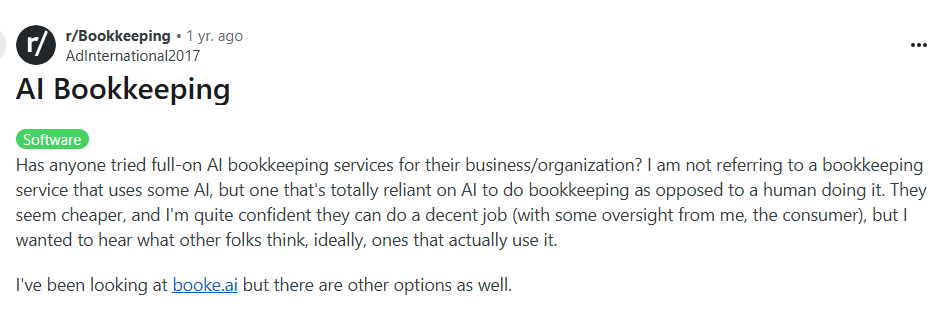
To bring this topic into the real world, here’s a glimpse of what people are saying about AI bookkeeping in a recent Reddit conversation:
VI. Challenges and Considerations
As useful as AI is, it’s not always easy to implement. Smaller businesses often worry about the cost and complexity. It’s important to weigh the long-term benefits against short-term hurdles.
To adopt AI responsibly and effectively, firms need to navigate several key areas, as follows:
a. Data privacy concerns and compliance with regulations like PIPEDA
Firms must:
- Use encrypted platforms
- Get client consent for AI use
- Store data in secure servers
AI tools must protect client data as per Canadian privacy laws. Firms should ensure that software providers are PIPEDA-compliant. This protects businesses from legal issues.
b. Integration challenges with existing accounting systems
c. Cost implications for small and medium-sized enterprises (SMEs)
VII. Future Outlook
Looking ahead, new technologies are set to redefine accounting practices through the following:
a. Emerging AI technologies poised to revolutionize accounting further
Technologies include:
- Natural language processing
- Voice-command interfaces
- Auto-learning recommendation engines
These will take efficiency to the next level. Voice commands, AI chatbots, and deeper analytics are on the horizon. These tools will make bookkeeping and accounting even faster. Automation will become the standard.
b. Potential for AI to offer more personalized financial services
AI will tailor insights based on your industry, revenue, and goals. This makes advice more accurate and useful. One-size-fits-all solutions will become a thing of the past.
c. The evolving landscape of accounting education and training in Canada
Now that we’ve seen the impact, let’s explore the tech making it possible.
VIII. AI Tools and Platforms in the Canadian Market
From startups to scaling enterprises, the most effective AI tools for bookkeeping are highlighted below:
a. Overview of prominent AI-powered accounting tools used in Canada
Top tools include:
b. Comparative analysis of features, pricing, and suitability for different business sizes
Startups may prefer simpler, low-cost tools, while larger firms need more integrations. Pricing depends on user limits and features. One Accounting can guide you through the selection.
IX. Regulatory and Ethical Implications
To ensure trust and fairness, firms must address key ethical and regulatory issues, as follows:
a. Discussion on the ethical use of AI in accounting practices
b. Regulatory frameworks governing AI applications in finance
c. Strategies for ensuring transparency and accountability
X. Integration of AI with Emerging Technologies
a. Exploration of how AI integrates with technologies like blockchain and machine learning
b. Impact on real-time auditing and continuous monitoring
AI enables:
- Ongoing checks on financial data
- Automatic red-flag alerts
- Streamlined compliance reports

c. Potential for creating more secure and transparent financial systems
With so many advancements in motion, it’s time to sum up what this all means for Canadian businesses.
Conclusion
At One Accounting, we combine expert advice with AI-powered tools to deliver the best of both worlds. Whether you need help getting started or scaling your financial systems, we’re here to guide you every step of the way. Let us simplify your bookkeeping and accounting with smart solutions tailored just for you.

Keith Jacob Noronha
CA — Accounting Manager, One Accounting
Keith Jacob Noronha is a Chartered Accountant (CA) and the Accounting Manager at One Accounting. Keith brings strong technical expertise in bookkeeping, corporate tax compliance, and financial management, supporting a wide range of business clients across Canada. As Accounting Manager, he oversees day-to-day accounting operations, coordinates client engagements, and ensures that all deliverables meet the firm's high standards for accuracy and timeliness. Keith's hands-on approach and deep understanding of Canadian accounting practices make him a trusted resource for clients navigating complex financial requirements.
- Phone: +1 647-556-1299
- Email: [email protected]
