GST/HST Credit Payment Dates in Canada
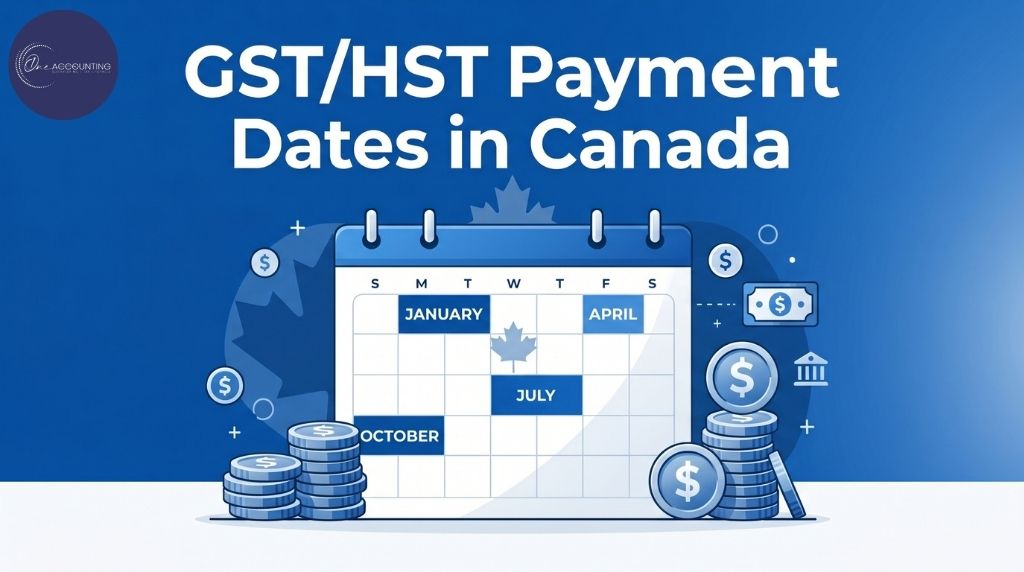
The Canada Revenue Agency (CRA) distributes GST/HST credit payments quarterly to eligible individuals throughout the year. For 2026, the scheduled payment dates are January 5, April 3, July 3, and October 5. These non-taxable payments help low- and moderate-income Canadians offset the cost of Goods and Services Tax (GST) and Harmonized Sales Tax (HST), with payment amounts based on household income and family size.
2026 GST/HST Credit Payment Schedule
You will receive your GST/HST credit payments four times a year.
- January 5, 2026
- April 3, 2026
- July 3, 2026 (under the new CGEB program)
- October 5, 2026 (under the new CGEB program)
GST/HST Credit Is Changing in July 2026
Starting in July 2026, the GST/HST credit will be renamed and issued under the new Canada Groceries and Essentials Benefit (CGEB) program. While payment dates remain on the same quarterly schedule, July and October 2026 payments will be issued under the new program name.
Who Qualifies for GST/HST Credit?
You need to meet a few basic requirements to qualify for the GST/HST credit:
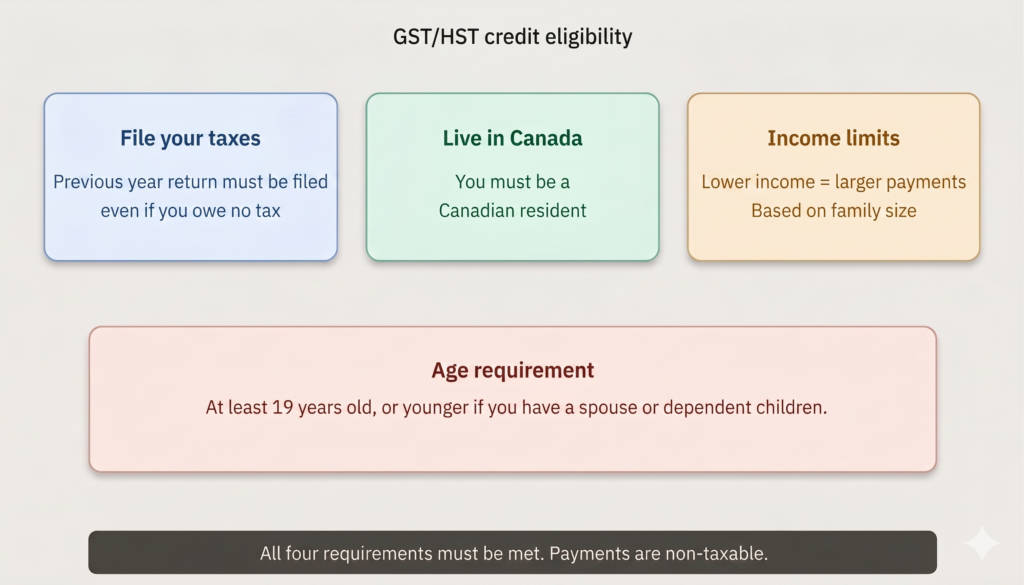
These payments are non-taxable, which means you won’t owe tax on the money you receive. The CRA calculates your eligibility based on your most recent tax return, so changes in your income or family situation may affect future payments.
How Much Can You Receive?
Your maximum credit for the July 2025 – June 2026 period breaks down like this:
- Single individual — up to $533/year
- Married or common-law couple — up to $698/year
- Each child under 19 — an additional $184/year
That said, these are the ceilings. As family income increases, the credit amount decreases, and past a certain threshold, the credit phases out entirely. The CRA calculates your credit automatically when processing your tax return. If your calculated amount comes to less than $50 per quarter, the CRA may issue the full yearly amount as a single payment in July as a single payment in July.
How the CRA Calculates Your Credit
Three things determine your amount:
- Your adjusted family net income
- Your marital status
- Number of eligible children under 19 registered for the Canada Child Benefit or GST/HST credit
Every July, the CRA recalculates using your previous year’s tax return. So your July 2025 – June 2026 payments are based on what you reported for 2024. Filing late may delay your payments.
Your amount can also shift mid-year if any of these happen:
- A child in your household turns 19
- Your marital status changes
- The number of children in your care changes
- A custody arrangement changes
- A member of your household passes away
You don’t need to trigger a recalculation yourself; just keep your CRA information current, and the CRA will handle the rest.
How Payments Are Sent
The CRA sends your payment one of two ways:
- Direct deposit — lands in your bank account on the payment date
- Check by mail — takes a few extra days depending on where you live
Direct deposit is generally the fastest option. Set it up or update your banking details through CRA My Account. You can also sign up for email reminders — the CRA sends one about a week before each payment goes out, so you always know when to expect it.
What If Your Payment Is Late or Missing?
Start with CRA My Account. Check there first before contacting the CRA. It will show whether your payment was issued and when.
If it was issued but hasn’t arrived, delivery times may vary depending on the payment method. Direct deposit typically arrives the same day. Checks take longer.
If payments have stopped entirely, here are the common reasons:
- You didn’t file your tax return
- You didn’t reply to a letter from the CRA
- Your address or banking info is outdated
- Your marital status changed and wasn’t reported
- Your income is now too high
- You no longer meet the Canadian residency requirements
- You have an outstanding debt or overpayment — the CRA will hold your payments until it’s cleared
If your payment still has not arrived after checking your account, contact the CRA directly.
FAQ's
Do I need to apply every year?
No. File your tax return and the CRA automatically checks if you qualify. Nothing extra is needed.
Is this money taxable?
Not at all. You don’t report it as income, and it won’t affect your tax return.
I had zero income this year — can I still get it?
Yes, as long as you file a return. The CRA needs that to assess your eligibility, even if there’s nothing to report.
Share:
Recent Blogs
Everything You Need to Know About Quebec Payroll
The Ultimate Guide to Canadian Year-End Payroll
What you need to know about Canada’s New Dental Care Plan
Disclaimer: Information shared in this blog is general in nature and may not apply to all situations or circumstances. Contact One Accounting for accurate, professional advice.

Sunith Varkey
Founder & Partner | One Accounting Professional Corporation
Sunith Varkey is a Chartered Professional Accountant (CPA, CA) and Founder of One Accounting Professional Corporation, bringing over 17 years of international experience in accounting, financial management, Canadian corporate taxation, and business advisory.
Sunith qualified as a Chartered Accountant in South Africa in 2012 and subsequently obtained his Canadian CPA designation in 2015. Throughout his career, he has held senior financial leadership and executive positions with large multinational corporations, publicly listed business groups, and growing private enterprises, gaining extensive experience in financial management, corporate governance, and strategic decision-making.
Since founding One Accounting in 2020, Sunith has focused on helping small and medium-sized businesses navigate the complexities of accounting, taxation, and financial management. Today, he leads a team of accounting professionals helping Canadian businesses with bookkeeping services, corporate tax compliance and planning, financial reporting, and strategic business advisory.
Combining his corporate finance background with an entrepreneurial perspective, Sunith takes a practical, results-oriented approach to helping businesses improve financial visibility, maintain compliance, and achieve sustainable growth.
Through his articles, he shares practical insights on Canadian taxation, accounting, financial management, and business strategy to help entrepreneurs and business owners make informed financial decisions.
- Phone: +1 416-319-9207
- Email: [email protected]
